Episode Overview
Canada used to lead the world in blood pressure control, but treatment and control rates have slipped in recent years. In this episode, host Dr. Goldis Mitra sits down with Dr. Jesse Bittman, a General Internist with focused training in obesity medicine, hypertension, and cardiovascular risk management, to unpack the new 2025 Hypertension Canada Primary Care Guidelines. Together they cover the new single blood pressure target for (almost) everyone, the lifestyle changes that make the biggest difference to blood pressure and cardiovascular risk, and the stepwise, single-pill-first approach to medications.
This is Part 4 of our cardiovascular risk series. Catch up with Episode 2 (cardiovascular risk factors), Episode 3 (why knowing your blood pressure matters), and Episode 7 (how to measure your blood pressure at home) if you haven't already.
Key Pearls
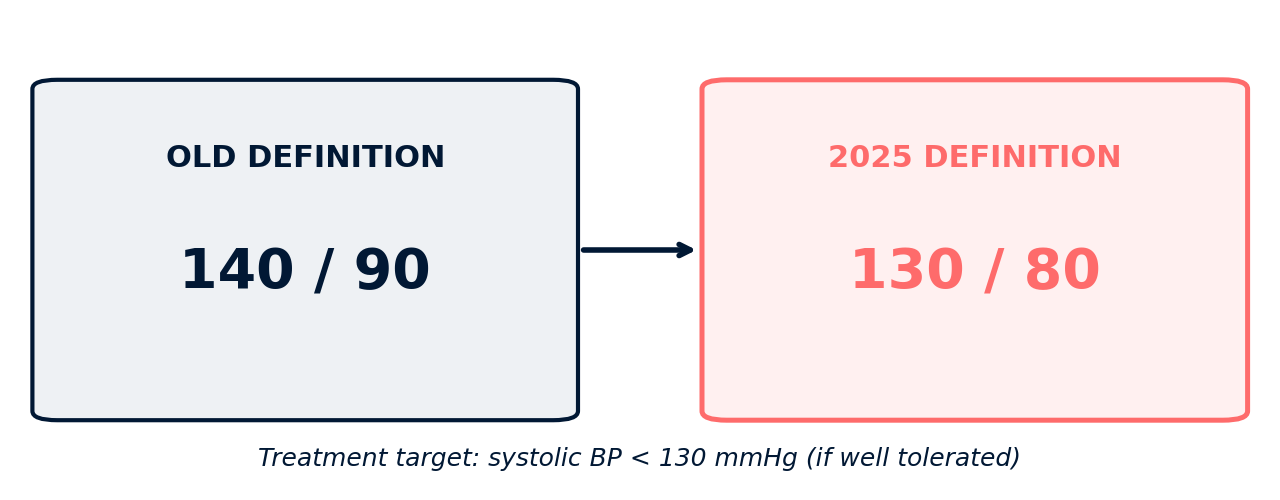
- High blood pressure is now defined as ≥130/80 mmHg on a validated, upper-arm automated device; down from the old 140/90 threshold.
- For most adults with hypertension, the treatment target is a systolic BP < 130 mmHg, if well tolerated. Older or frail patients may have an individualized, higher target.
- Lifestyle change is the first thing anyone should do to manage their blood pressure: sodium reduction (< 2 grams per day), a potassium-rich diet, weight management, 150-300 minutes/week of aerobic activity, and cutting back on alcohol all lower blood pressure.
- Medication starts immediately at ≥140/90 mmHg, or in the 130-139 mmHg systolic range only if the patient has high cardiovascular risk (talk to your doctor!).
- The new default is low-dose combination therapy up front, ideally a single pill, rather than starting one drug at a time.
The New Definition & Target: 130/80 Is the New Standard
The 2025 Hypertension Canada Primary Care Guideline replaces the old patchwork of disease-specific targets with one definition for nearly every adult: high blood pressure is now defined as 130/80 mmHg or higher, measured on a validated automated device. This is a meaningful drop from the previous 140/90 mmHg threshold.
Why the change? Observational data show cardiovascular risk increases continuously from a systolic pressure as low as 90 mmHg, and people in the 130-139/85-89 mmHg range already carry roughly 1.5-2x the risk of a major cardiac events compared to those under 120/80. Landmark trials SPRINT, ESPRIT, and BPROAD all reinforce that more intensive blood pressure lowering meaningfully reduces risk of stroke, heart attack, and death. For every 10-point drop in systolic pressure in high-risk patients, stroke risk falls by roughly 60%.
For most adults with high blood pressure, the treatment target is a systolic blood pressure under 130 mmHg, as long as medications are well tolerated. Aggressive blood pressure lowering does carry a small but real risk of low blood pressure, falls, electrolyte problems, and kidney injury. So in older, frailer patients, or those prone to falls or lightheadedness, the guideline allows a more individualized target: “as low as reasonably achievable and well tolerated.”
Accurate measurement is very important. The guideline strongly recommends a validated, upper-arm automated blood pressure device (typically not a wrist cuff), with regular home readings logged over time: Your average blood pressure over multiple days and weeks, not a single high number, are used to diagnose high blood pressure. (For a full walkthrough of home blood pressure monitoring, see Episode 7.)
Lifestyle First: Diet, Weight, and Exercise
Sodium & potassium
The target is under 2 grams of sodium a day (equivalent to roughly 5 grams of table salt). Since over 70% of dietary sodium comes from processed and packaged foods rather than the salt shaker, the most effective advice is often “cook more from scratch” rather than “put the shaker down.”
A diet rich in fruits, vegetables, and low-fat dairy, aiming for over 3.5 g of potassium a day, reliably lowers blood pressure. Always talk to your doctor first - we will sometimes be careful with certain diets in patients with kidney disease or on medications that raise potassium).
Weight management
The effect of weight management on blood pressure is significant, and the more weight you lose, the better your blood pressure will typically be controlled. Structured weight-loss programs lower systolic pressure by about 4.5 points on average, while GLP-1 medications like semaglutide (Ozempic) have shown roughly a 5-point systolic drop alongside about 12% weight loss in trials. Maintaining a healthy body weight (BMI 18.5-24.9, waist circumference under 102 cm for men and 88 cm for women) is recommended to prevent hypertension in the first place.
Exercise
150–300 minutes a week (20–40 minutes a day) of moderate aerobic activity (brisk walking, cycling, swimming) can lower systolic pressure by about 7 points on its own in people with hypertension.
Resistance or weight training is also important and encouraged. It is a myth that weight training causes a person to have high blood pressure.
Substances That Raise Blood Pressure: Alcohol & Smoking
Alcohol's effect on blood pressure is dose-dependent and best assessed over a full week rather than per-day: someone having 2-3 drinks a night can add up to 15-20 drinks a week, a level associated with measurable effects on liver, heart, brain, and blood pressure. Cutting back has a real impact; someone drinking 3+ drinks a day who cuts back can see systolic pressure drop by roughly 1-5 points. Canadian low-risk drinking guidelines suggest limiting alcohol intake to 0-2 drinks per week.
Smoking has only a modest direct effect on blood pressure itself, but quitting remains one of the single most important things a person can do to reduce their overall risk of cardiovascular disease.
When to Start Medication
Your doctor and medical team should guide you through the decisions around medications.
Two clear thresholds guide the decision to start medications for high blood pressure:
Confirmed blood pressure ≥140/90 mmHg: start medication right away, regardless of overall risk profile.
Systolic blood pressure 130-139 mmHg: start medication only if the person is at high cardiovascular risk; established cardiovascular disease, type 1 or 2 diabetes, chronic kidney disease, a 10-year Framingham risk score ≥20%, or age ≥75.
Without one of those high-risk features, the guideline favors holding off on medication, leaning into lifestyle change, and reassessing blood pressure in 3-6 months.
Medications for high blood pressure
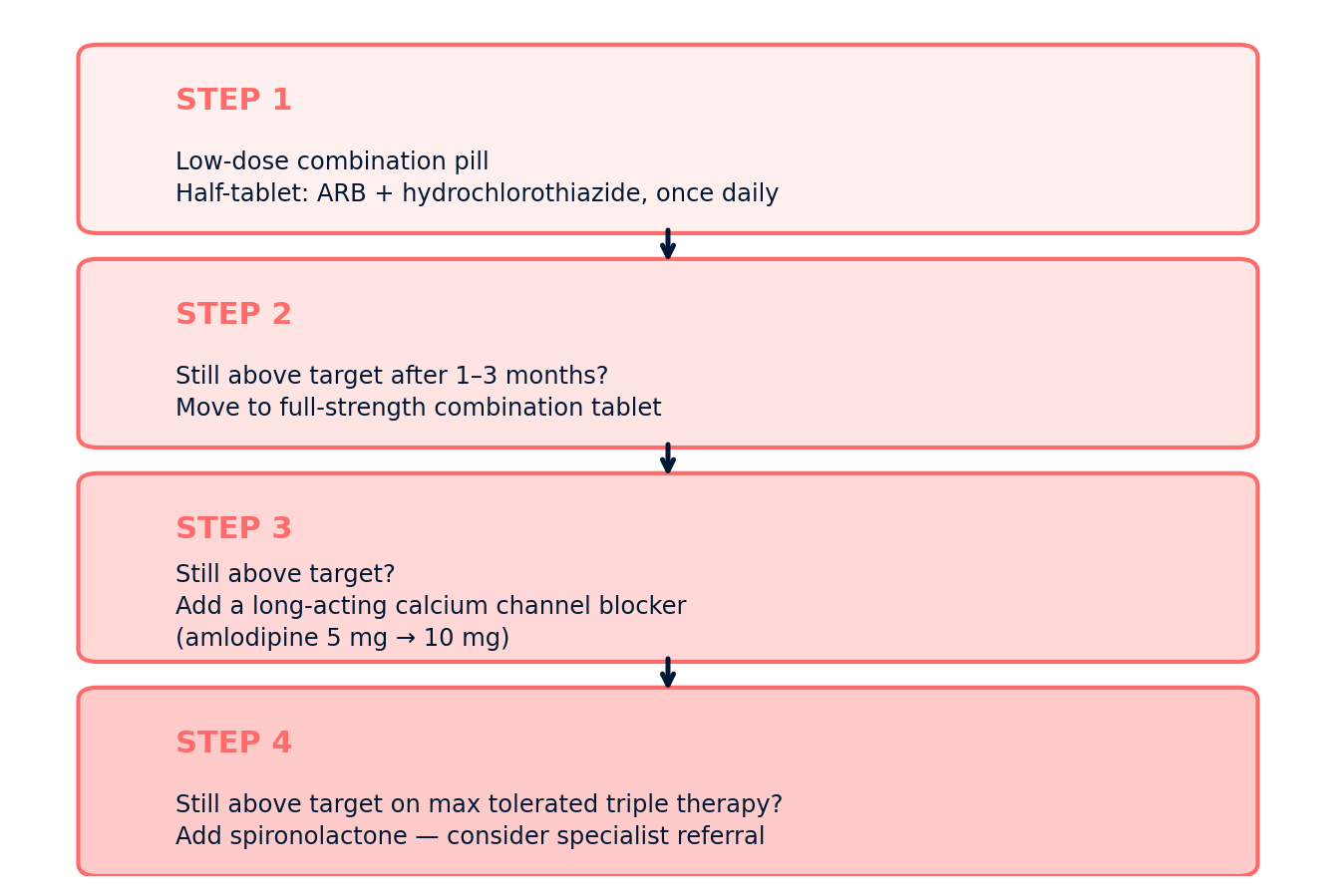
The biggest shift in the 2025 guideline is starting treatment with low-dose combination therapy up front rather than the old “one drug, then wait and see” approach. Combining two low-dose drugs from different classes is more effective, causes fewer side effects, improves adherence, and is usually less expensive than filling two separate prescriptions.
Doctors will individualize your therapy based on your underlying medical conditions, and after speaking to you about the potential benefits and side effects of the different medication classes.
Step 1: you will typically start on a low-dose combination pill (or the same medications but purchased as 2 different pills). Typically you will be started on a low dose of a combination of two medications: an ARB, which stands for angiotensin receptor blocker, and hydrochlorothiazide, taken once daily. ARB medications typically end in ‘-sartan,’ such as candesartan or losartan.
Step 2: if blood pressure is still above target after 1-3 months, the recommendation is typically to increase the dose of your medications.
Step 3: If after 1-3 months your blood pressure is still not at target, you can increase the dose of your current regimen (if it’s well tolerated) or add a third class of medications — a long-acting calcium channel blocker like amlodipine.
Step 4: If after 1-3 months your blood pressure is still not at target, you may need a higher dose of that 3rd medication or addition of a 4th medication. At this point consideration is often made to investigate other underlying causes of high blood pressure or to refer to a blood pressure specialist.
Take-Home Message
Blood pressure naturally varies throughout the day and night, and what matters is your average over time. If that average is consistently at or above 130/80 mmHg, lowering your blood pressure reduces your risk of stroke, heart attack, heart failure, and kidney disease in the future.
Working with your family doctor, internist, or kidney specialist to address lifestyle changes and (when appropriate) medication gives you the best chance at managing blood pressure over the long run.
References
- Hypertension Canada. 2025 Primary Care Guideline for the Diagnosis and Treatment of Hypertension in Adults in Primary Care.
- SPRINT Research Group. A Randomized Trial of Intensive versus Standard Blood-Pressure Control. N Engl J Med. 2015;373:2103-2116.
- Liu J, Li Y, Ge J, et al; ESPRIT Collaborative Group. Lowering systolic blood pressure to less than 120 mm Hg versus less than 140 mm Hg in patients with high cardiovascular risk. Lancet. 2024;404:245-255.
- Bi Y, Li M, Liu Y, et al; BPROAD Research Group. Intensive Blood-Pressure Control in Patients with Type 2 Diabetes. N Engl J Med. 2024.
- Williams B, MacDonald TM, Morant S, et al. Spironolactone versus placebo, bisoprolol, and doxazosin to determine the optimal treatment for drug-resistant hypertension (PATHWAY-2). Lancet. 2015;386:2059-2068.